The web dashboard
ot web # → http://127.0.0.1:8787
The dashboard is the desk's front end. It runs locally, reads your watchlist, and degrades gracefully to keyless data panels when no LLM engine is configured.
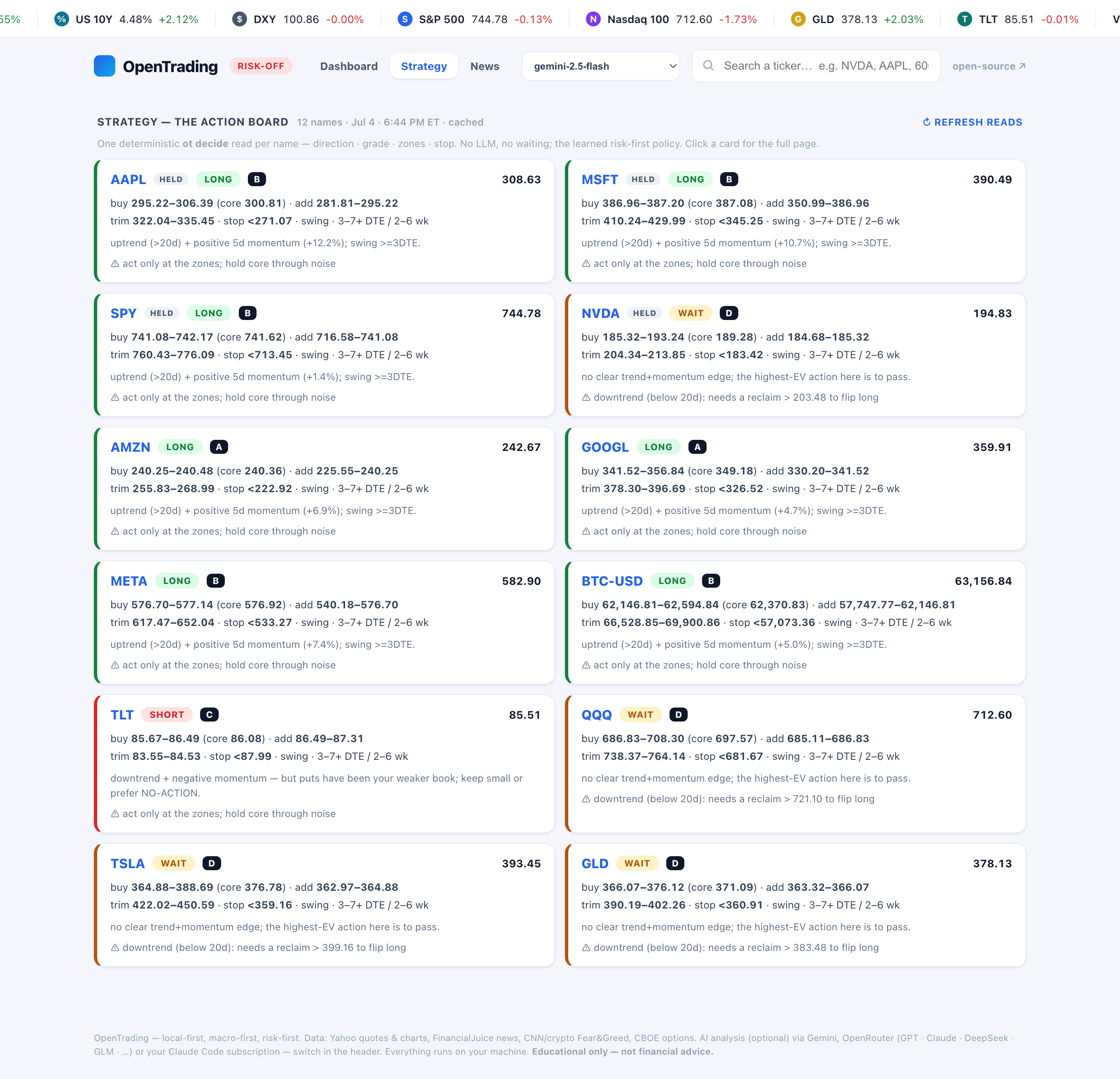
Reading a ticker page (top to bottom)
- Consensus strip — one chip per analyst (engine, quant, TimesFM, AI, debate), colored by its tilt. The verdict is computed from the votes: CONSENSUS LONG/SHORT when 2+ agree and none oppose, NEUTRAL with no majority, THIN when too few have reported, and ⚠ STAND ASIDE the moment any two analysts point in opposite directions.
- Chart + walls + cones — price with the dealer call/put walls and the
forecast cones overlaid. The wall DTE window is tunable from the
Confluence-ladder header (
0DTE / 5 / 7 / 14 / 30 / 45 / 60 / 90) — pick 0DTE for intraday pin risk, longer windows for swing structure. The ladder shows the net GEX at that window, which shifts as you widen it. - Bull vs Bear — the committed call: a 5-tier verdict with entry, invalidation and a time stop. See the debate.
- Confluence ladder — every price level the desk emits on one axis; the rows
named by 2+ independent methods (marked
×2) are the ones that matter. - AI analysis — a grounded second opinion: summary, action, sentiment gauge, sniper levels and risks.
Switching the engine
The header has a model dropdown. It controls the AI Analysis and News Analysis panels; results are cached per (ticker, engine, model).
The debate has its own engines pill — click it to open a small picker
with three modes:
- diverse (default) — bull and bear run on different engines for perspective diversity; the judge on Claude.
- single — all three roles run on the header engine·model you selected (the pill mirrors it live as you change the header).
- custom roles — three dropdowns appear: pick an engine·model for the bull, the bear and the judge independently (leave any on auto for the desk default). Great for A/B-ing judges or pitting two models against each other.
Switching costs no tokens; the new assignment applies on the next run. Note
that Claude Code · default (and Codex default) means your CLI's own
default model — change it with /model in the CLI, or pin one here.
Your verdict is cached one-per-(ticker, language) and mirrored to
data/debate-cache.json, so it never disappears when you change the engine
picker and it survives an ot web restart — hit ↻ to re-run with the
current engines.
English / 中文
A 中文 / EN toggle in the header (or ?lang=zh) flips the entire UI and the
model's output between English and Simplified Chinese — the same desk for a US
book or an A-share / HK book.
The Learn tab
#/learn is the built-in textbook. Every module on a ticker page has a ? help
chip that jumps to the matching explainer — the confluence ladder, forecast
cones, dealer gamma, smart money, calibration — each with a worked real-world
example. Start there when a number isn't obvious.
Macro & Flow
The dashboard home shows the global picture: the macro score (rates & liquidity), Fear & Greed, BTC funding, SPY dealer gamma, Hyperliquid perps, on-chain whale flow, engine diagnostics, and Polymarket crowd odds.